Tulum Taxi Fares in 2026: What Residents and Visitors Need to Know
Originally published by Christie’s Real Estate Mexico on October 12, 2026. This is a full republication of the original article.
Information reviewed October 13, 2026
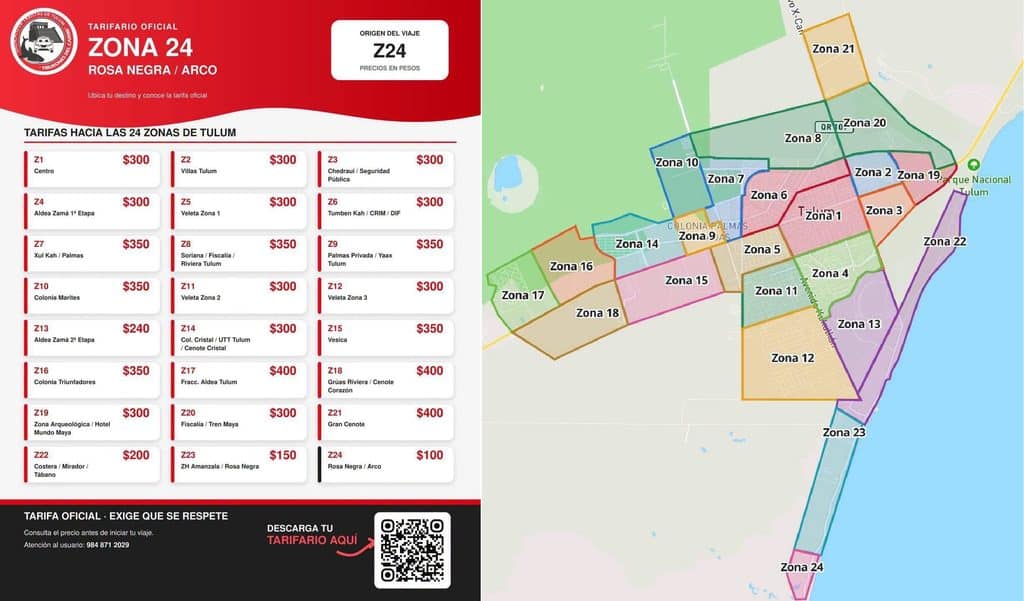
In September, a new taxi fare chart divided into 24 zones began circulating in Tulum. For residents, visitors, and anyone considering living in Tulum, one key distinction matters: the Tiburones del Caribe taxi union distributed the document, but it is not a newly authorized fare schedule from the Government of Quintana Roo.[1] [2]
IMOVEQROO, Quintana Roo’s state mobility authority, said it did not authorize the new chart. The most recent official Tulum tariff we could identify was published in the Periódico Oficial del Estado de Quintana Roo on October 17, 2019.[3]
In practice, the new chart may influence the price a driver quotes today. On its own, it does not replace a fare officially approved by the state. For anyone who uses taxis regularly in Tulum, understanding that difference makes it easier to know what to ask before starting a trip.
What actually changed in September 2026?
The chart the taxi union distributed expands the pricing map from the 18 zones referenced in the 2019 schedule to 24. It covers trips within Tulum and toward destinations including the archaeological zone and different sections of the coast.[2] [3]
For passengers, this creates a more detailed price reference based on where a trip begins and ends. However, a pricing chart used or proposed by the taxi union differs from a fare officially authorized by the state.
Who can authorize taxi fares in Tulum?
Quintana Roo’s Mobility Law establishes how public transport fares are determined. Under Articles 94 and 95, IMOVEQROO sets and publishes the applicable fares by agreement, and the state’s Periódico Oficial must publish authorized fares before they become mandatory.[1]
A taxi union can therefore create and distribute its own pricing chart, but that document does not automatically become a new state tariff. La Jornada Maya also reported that the chart circulated in September did not display an agreement number, official signature, seal, authorization date, or reference to an IMOVEQROO publication.[2]
The most recent government document we could identify as a reference for Tulum still points to the state tariff update published on October 17, 2019. We did not identify a later IMOVEQROO agreement that replaced it for Tulum.[3]
How do the 24 zones work?
The new chart calculates a fare based on the zone where a trip begins and ends. That means simply asking for a ride to “Centro,” “La Veleta,” or “the beach” may not always be enough to establish the exact price.
Tulum Centro, La Veleta, Aldea Zamá, the archaeological zone, and the different sections of the coast are treated as separate areas. A trip to “the beach,” in particular, could end at many different points along the Tulum-Boca Paila road, with considerable differences in distance.
For that reason, it is better to give the driver the exact property, entrance, or address and ask for the total fare before beginning the trip. The 24-zone map can help explain how a quote is being calculated, but it should be distinguished from a state-authorized fare map.[2]
How do some of the prices compare?
La Jornada Maya compared several examples from the September 2026 union chart with amounts reported under the 2019 state schedule. The examples below help illustrate the difference between the two documents, but they should not be treated as a complete guide to current fares for every address in Tulum.[2]
| Trip or area | 2019 state tariff, as reported | September 2026 union chart, as reported |
|---|---|---|
| Tulum Centro to Yaax Tulum | MXN $32 | MXN $70 |
| Tulum Centro to the archaeological zone | MXN $49 | MXN $90 |
| La Veleta example | MXN $31 | MXN $50, $80 or up to $100, depending on the new zone |
La Veleta is a good example of why these figures need context. Under the new chart, the area is split into three zones, so this isn’t one identical trip offered at three different prices. The precise address changes the zone and, therefore, the quote.
For the same reason, we haven’t identified a single reliable figure we can present as the price from “Tulum Centro to the beach.” The specific coastal destination matters.
Are taximeters coming to Tulum?
Following the dispute over the new fare chart, IMOVEQROO’s director publicly discussed introducing taximeters in Tulum to provide greater clarity on pricing. The issue had already appeared among the priorities discussed during a tourism-sector meeting with IMOVEQROO in March 2026.[4] [5]
As of our October 13 review, we had not found a published date for a general rollout in Tulum, an official taximeter fare, or confirmation that meters had entered widespread use.
For now, the most practical approach is still to confirm the full price before starting a trip rather than assuming the taxi will use a meter.
What to do before taking a taxi in Tulum
The simplest advice is also the most useful: give the driver your exact destination and ask for the total price in Mexican pesos before getting into the vehicle. If the trip will include waiting time or an additional stop, agree on that at the same time.
If a driver shows you a fare chart or QR code, you can use it to understand how the price is being calculated. That does not necessarily mean the document shown is an officially authorized state tariff.
If the quote is unclear, you can ask for another before beginning the trip. If you later decide to report a charge, it is useful to keep the vehicle or license plate number, route, time, quoted or charged amount, and any available receipt.
IMOVEQROO’s current directory lists its Tulum delegation at [email protected] and 800-801-0189, extension 400. The Government of Quintana Roo has also published 983-185-3403 as a WhatsApp number for reporting transport-related irregularities.[6]
Why transportation matters when choosing where to live in Tulum
Day-to-day transportation is also worth considering when comparing properties in Tulum. Two locations can look close on a map but offer very different experiences once you consider road access, traffic, and regular trips to the beach, town, restaurants, or services.
A property in La Veleta, Aldea Zamá, or another part of Tulum may suit how you plan to use it. Look beyond broad descriptions such as “close to the beach” and understand what everyday journeys will actually be like.
Sources
- Quintana Roo Mobility Law, latest amendment published March 5, 2026, Articles 94 and 95.
- La Jornada Maya, September 3, 2026, covering the 24-zone fare chart and reported fare comparisons.
- Territorial Operating Program for the Southern Riviera Maya, SEDATU, citing the Quintana Roo government tariff update published October 17, 2019.
- Grupo Animal, September 8, 2026, covering IMOVEQROO’s response and discussion of introducing taximeters.
- Second IMOVEQROO meeting, March 2, 2026, listing implementation of taximeters in Cancún and Tulum among the transportation system topics discussed.
- IMOVEQROO’s Tulum delegation directory and the Government of Quintana Roo’s published transport complaint channel.